


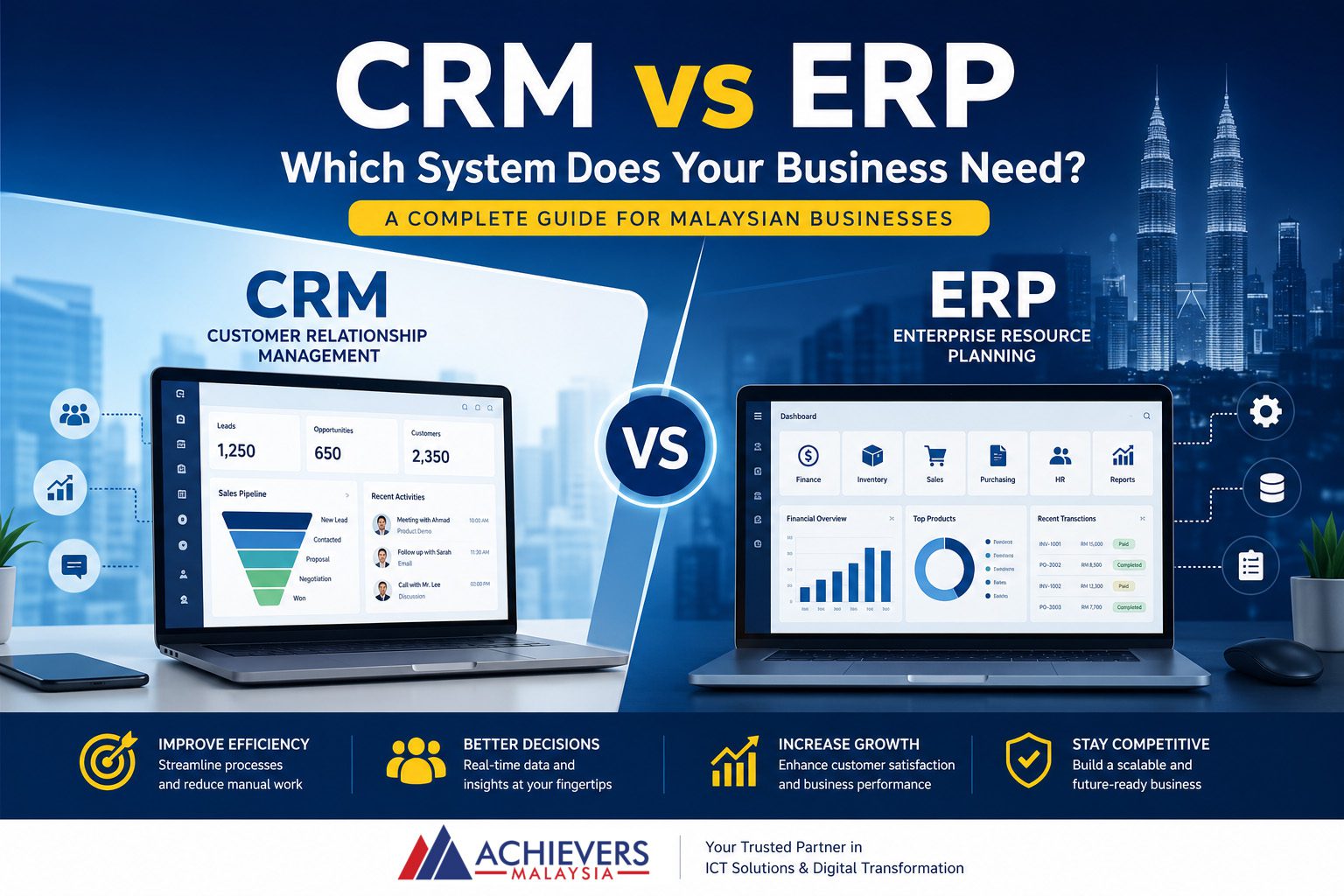
CRM vs ERP: Which Business Management System Is Right for Your Company?
As businesses grow, managing operations becomes increasingly complex. Customer enquiries arrive through multiple channels, inventory levels fluctuate daily, finance teams require accurate reporting, and management expects real-time information to support decision-making. While spreadsheets and standalone software may work during the early stages of a business, they often become barriers to efficiency as the organisation expands.
Many Malaysian businesses reach a point where they realise their existing systems no longer support their growth. Sales teams struggle to track customer interactions, departments maintain separate databases, and valuable information becomes scattered across different applications. These challenges not only reduce productivity but also affect customer satisfaction and profitability.
This is where business management systems such as Customer Relationship Management (CRM) and Enterprise Resource Planning (ERP) become essential. Although these terms are frequently mentioned together, they serve different purposes. Understanding the distinction between them is the first step towards making a sound technology investment.
Understanding Customer Relationship Management (CRM)
A Customer Relationship Management (CRM) system is designed to help businesses build stronger relationships with customers throughout the entire sales journey. Rather than storing customer information in emails, spreadsheets, or individual employee records, a CRM provides a centralised platform where every interaction is recorded and accessible.
Whenever a customer submits an enquiry, requests a quotation, or contacts your support team, the information is stored in one place. Sales representatives can immediately view previous conversations, understand customer preferences, and continue discussions without unnecessary delays. This improves response times while creating a more consistent customer experience.
Modern CRM platforms also provide powerful reporting capabilities. Managers can monitor sales performance, identify opportunities that require attention, forecast future revenue, and evaluate the effectiveness of marketing campaigns. Instead of relying on assumptions, management gains access to data-driven insights that support better business decisions.
For organisations focused on increasing sales, improving customer service, or strengthening client relationships, implementing a CRM system often delivers immediate operational improvements.
Understanding Enterprise Resource Planning (ERP)
While CRM focuses on customers, an Enterprise Resource Planning (ERP) system manages the internal operations of a business. It connects different departments through a single integrated platform, allowing information to flow seamlessly between finance, procurement, inventory, human resources, manufacturing, and project management.
Without an ERP system, employees often duplicate work by entering the same information into multiple software applications. Inventory records may not match accounting reports, procurement teams may lack visibility into stock levels, and management may struggle to obtain accurate financial information quickly.
An ERP eliminates these inefficiencies by creating a single source of truth for the organisation. Once information is entered into the system, it becomes available to authorised departments automatically. This reduces manual work, improves data accuracy, and enables faster decision-making across the business.
As organisations expand, an ERP provides the operational foundation needed to support sustainable growth while maintaining consistency and compliance.
CRM and ERP: Different Purposes, Shared Objectives
Although CRM and ERP systems address different business functions, they ultimately contribute to the same organisational objective: improving business performance.
A CRM is primarily concerned with generating revenue by helping businesses attract, manage, and retain customers. It supports sales teams, marketing departments, and customer service personnel by providing comprehensive information about every client interaction.
An ERP, on the other hand, focuses on operational excellence. It ensures that inventory, finance, procurement, human resources, and other internal processes operate efficiently through automation and integration.
Rather than competing technologies, CRM and ERP complement one another. Many successful organisations implement both systems because customer satisfaction depends not only on winning new business but also on delivering products and services efficiently.
How Do You Know Your Business Needs a CRM?
Businesses often recognise the need for a CRM when customer information becomes difficult to manage. Sales representatives may maintain separate spreadsheets, follow-up activities become inconsistent, and management lacks visibility into sales opportunities.
These issues often result in missed business opportunities, slower response times, and reduced customer satisfaction. A CRM addresses these challenges by organising customer information within a structured system that improves collaboration and accountability across the sales process.
For organisations seeking to strengthen customer relationships while increasing revenue, a CRM represents one of the most valuable technology investments available.
When Is It Time to Implement an ERP?
Operational complexity usually signals the need for an ERP system. As businesses grow, separate accounting software, inventory applications, payroll systems, and procurement processes become increasingly difficult to manage.
Departments begin operating independently, information becomes duplicated, and reporting requires significant manual effort. These inefficiencies affect productivity and increase operational costs.
An ERP integrates these functions into a unified environment where information flows automatically between departments. Decision-makers gain immediate access to accurate operational data, allowing them to respond quickly to changing business conditions.
The Value of Integrating CRM and ERP
Increasingly, businesses are choosing to integrate CRM and ERP systems rather than treating them as separate solutions. Integration creates a seamless flow of information throughout the organisation.
For example, once a sales opportunity is successfully converted within the CRM, customer information can automatically be transferred into the ERP system. Finance teams can generate invoices, warehouse personnel can prepare deliveries, procurement departments can replenish inventory, and management can monitor project progress without duplicate data entry.
This connected approach reduces administrative work, improves communication between departments, and provides leadership with complete visibility across the organisation.
Choosing the Right Solution for Your Business
Selecting a CRM or ERP system should never be based solely on software features or price. Every organisation operates differently, with unique workflows, business objectives, and future growth plans.
A successful implementation begins with understanding existing business processes before identifying opportunities for automation and improvement. Factors such as scalability, system integration, user adoption, implementation methodology, and ongoing technical support are equally important considerations.
Businesses should also evaluate whether off-the-shelf software meets their operational requirements or whether a customised solution would provide greater long-term value.
Why Businesses Are Investing in Digital Transformation
Across Malaysia, organisations are embracing digital transformation to remain competitive in an increasingly technology-driven economy. Customers expect faster service, employees require better collaboration tools, and management depends on accurate information for strategic planning.
CRM and ERP systems are no longer viewed as optional software investments. Instead, they have become critical components of modern business infrastructure, enabling organisations to improve efficiency, reduce operational costs, and deliver superior customer experiences.
Companies that invest in integrated digital solutions today are better positioned to adapt to future market changes while maintaining sustainable growth.
Partner with Achievers Malaysia for Tailored ICT Solutions
At Achievers Malaysia, we believe that technology should simplify business operations rather than complicate them. Our team works closely with organisations to understand their unique requirements before designing solutions that align with their operational goals and future growth plans.
Our ICT solutions include custom CRM development, enterprise ERP implementation, multi-vendor marketplace platforms, corporate website development, mobile application development, cloud-based business systems, workflow automation, system integration, and ongoing technical support.
Rather than delivering generic software, we focus on building scalable digital solutions that improve efficiency, enhance customer engagement, and support long-term business success.
Final Thoughts
Choosing between CRM and ERP is not simply a technology decision—it is a strategic business decision. A CRM helps organisations build stronger customer relationships and increase revenue, while an ERP creates the operational foundation required to support sustainable growth. For many businesses, the greatest value comes from combining both systems into a fully integrated digital ecosystem.
As digital transformation continues to reshape industries across Malaysia, investing in the right business management system today can provide lasting competitive advantages for years to come.
